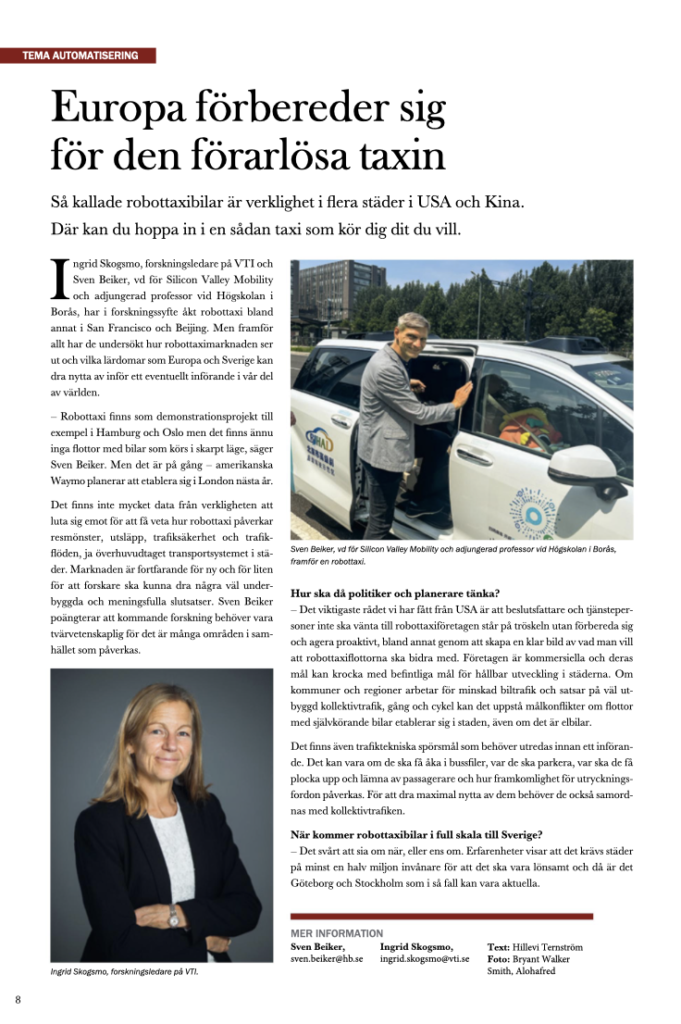
Earlier this year, I had the pleasure of being interviewed by VTI – the Swedish National Road and Transport Research Institute – for VTI aktuellt, their magazine covering research and developments across the transportation sector.
The interview focused on a topic that is becoming increasingly relevant not only in Silicon Valley, but also in Europe: robotaxis and the future of autonomous mobility.
Together with my colleague Ingrid Skogsmo at VTI, I have been studying the development of robotaxi services in the U.S. and China. We have also had the opportunity to experience these services firsthand, including rides in autonomous vehicles in San Francisco and Beijing. These experiences provide an interesting perspective on what is already possible today—and, perhaps more importantly, on what Europe needs to consider before large-scale deployment arrives.
One of the key challenges is that the robotaxi market is still relatively young. We simply don’t yet have enough real-world data to draw definitive conclusions about how autonomous taxi fleets will affect travel patterns, emissions, traffic safety, congestion, and the transportation system as a whole.
That means Europe has an opportunity to learn from the places where robotaxis are already operating.
My main message in the interview was that cities and policymakers should not wait until robotaxi companies are literally at their doorstep. They should start preparing now.
That preparation begins with a fundamental question: What do we actually want robotaxis to achieve?
If the objective is to reduce congestion, improve accessibility, complement public transportation, or provide mobility in areas that are difficult to serve today, then those goals should shape how the technology is introduced. Simply adding large numbers of autonomous vehicles to existing traffic does not automatically create a better transportation system.
There are also very practical questions to answer. Where should robotaxis pick up and drop off passengers? Should they have access to bus lanes? Where will they park or wait between trips? How do we make sure emergency vehicles can move efficiently? And, perhaps most importantly, how should robotaxis interact with public transportation, walking, and cycling?
These are not purely technology questions. They are transportation-system questions.
This is why I believe the European discussion around autonomous vehicles needs to go beyond whether the technology works. It is increasingly about how we integrate that technology into our cities and societies in a way that creates real value.
The U.S. and China are giving us valuable real-world experience. Europe now has the opportunity to learn from it—and to prepare thoughtfully rather than simply react when the technology arrives.
As I said in the VTI interview: we can create real societal benefits with this technology if we do it the right way.
You can read the full interview in VTI aktuellt here (Swedish only)
The original study “Learning for deployment of robotaxis at scale” can be found here (English)