
Bringing AI into the Product Development Classroom
One of the things I particularly enjoy about working between Silicon Valley and Sweden is the opportunity to bring ideas from industry and technology into the classroom—and then see those ideas develop further through academic research.
At the University of Borås, I teach and research Artificial Intelligence for Product Development and Innovation. This is an area where the pace of change is extraordinary. AI is no longer something that sits on the sidelines of product development; it is increasingly becoming part of how products are conceived, designed, developed, tested, and brought to market.
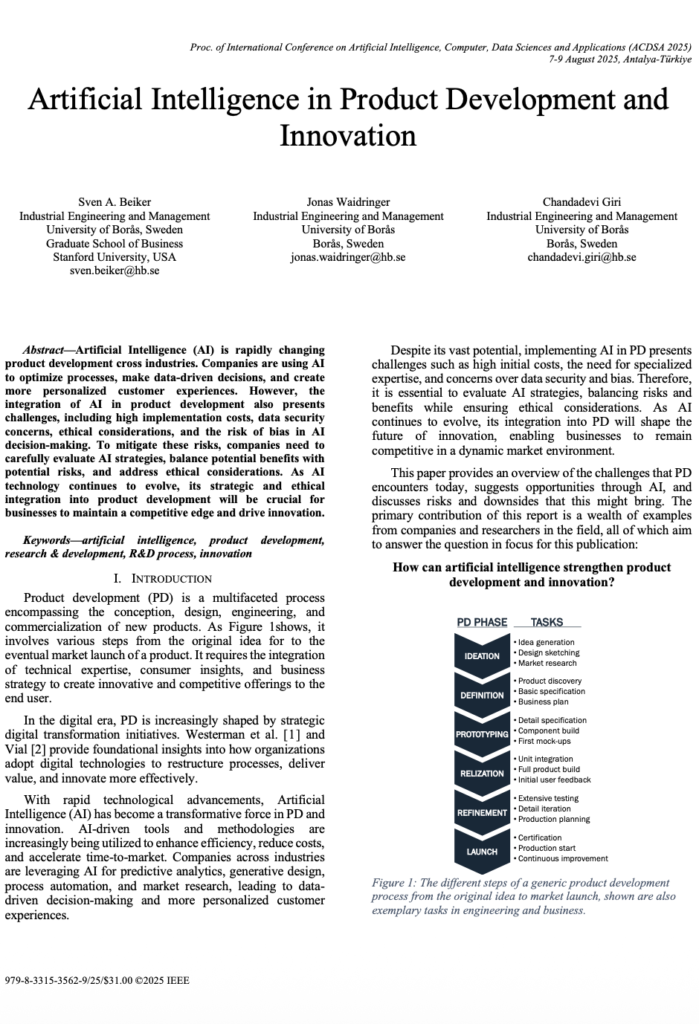
That experience led to a research paper that I recently had the pleasure of leading as first author: “Artificial Intelligence in Product Development and Innovation,” published in the IEEE proceedings of the 2025 International Conference on Artificial Intelligence, Computer, Data Sciences and Applications (ACDSA). The paper was written together with my colleagues Jonas Waidringer and Chanda Giri at the University of Borås.
From the classroom to research
The paper reflects many of the questions we explore with students in the course.
The obvious question is: What can AI actually do for product development?
The answer is becoming broader every day.
AI can help companies analyze large amounts of information, identify patterns, support engineering decisions, generate and evaluate design concepts, personalize products and services, and automate parts of the development process. More importantly, generative AI is changing the economics of experimentation: teams can explore more ideas, more quickly, and with fewer resources.
But the exciting part is not simply making existing processes faster.
The bigger opportunity is to rethink the product development process itself.
That requires looking at AI not just as another software tool, but as a technology that can change how organizations innovate.
The opportunities—and the complications
Our paper also emphasizes that adopting AI is not without challenges.
Companies need to consider implementation costs, data availability and quality, cybersecurity, intellectual property, ethical issues, and the potential for bias in AI-supported decisions.
And there is an important organizational dimension.
A company can have access to the latest AI models and still fail to create value if its people don’t know how to use them, if its data infrastructure isn’t ready, or if its product-development processes aren’t designed to take advantage of them.
This is why I believe AI literacy needs to become part of product-development education.
The engineers, designers, business leaders, and entrepreneurs who will create tomorrow’s products need to understand not only what AI can do, but also where it should—and should not—be used.
Teaching from both sides of the Atlantic
This is where my work at the University of Borås connects particularly well with my work in Silicon Valley and at Stanford.
In Silicon Valley, I spend much of my time looking at emerging technologies from the perspective of startups, established companies, investors, and mobility organizations. At Stanford, I teach students about technology-driven disruption and new business models. At the University of Borås, I have the opportunity to explore similar questions in a Swedish academic and industrial context.
The combination is valuable.
The classroom gives me the opportunity to step back from the day-to-day technology hype and ask more fundamental questions: Where does AI actually create value? What does it change? What new risks does it introduce? And how should organizations prepare?
At the same time, the rapidly changing technology landscape gives students real-world examples to analyze rather than purely theoretical cases.
That makes teaching AI particularly exciting right now.
The next generation of product development
I don’t think the future of product development will be about AI replacing product developers.
I think it will be about product developers who know how to work with AI outperforming those who don’t.
The competitive advantage will increasingly come from knowing how to combine human creativity, engineering expertise, business understanding, and AI capabilities.
That is ultimately what I hope to bring into the classroom at the University of Borås: not simply teaching students how to use today’s AI tools, but helping them understand how AI is changing the way products and businesses can be imagined, developed, and brought to market.
The technology will continue to evolve rapidly. The fundamental question remains the same:
How can we use it to build better products and create meaningful value?
That is a question worth researching—and, fortunately, a very interesting one to teach.