Interview: Self-driving cars are spreading across U.S. cities. Are they safe?

Interview: Self-driving cars are spreading across U.S. cities. Are they safe?

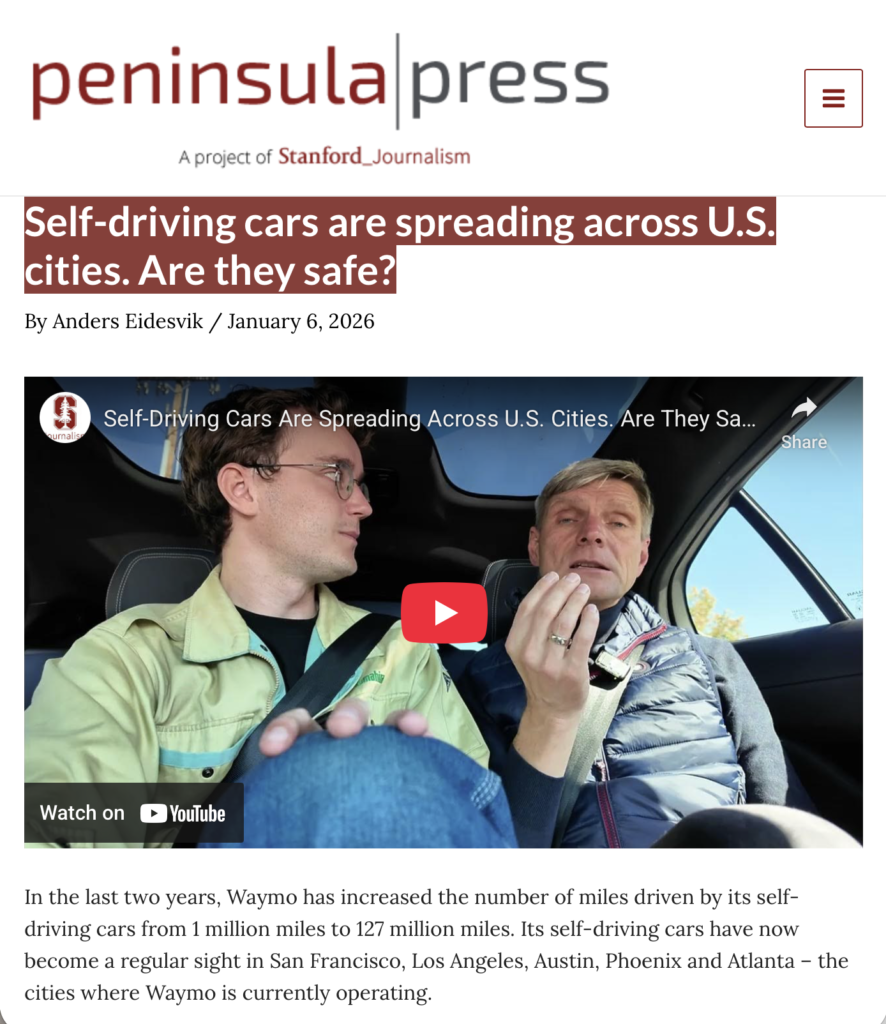
Here’s a nice video interview where I discuss how robotaxis work, why they are the better drivers, and where things are going – and all that while riding in a Waymo.

When I spoke with Anders Eidesvik for Peninsula Press, we focused on how quickly robotaxis are becoming normal in U.S. cities — and whether they’re actually safer. I pointed out that Waymo alone has already logged well over 100 million miles, which finally gives us meaningful safety data instead of just promises.

What those numbers show is pretty clear: these vehicles crash less often than humans and most incidents don’t even lead to injuries. A big reason is their sensor stack — lidar, radar, cameras — plus the fact that they don’t get tired, distracted, or overconfident like people do.

That said, I also stressed that widespread adoption will take time. Waymo is ahead, but others like Tesla and Zoox are still developing their systems, and fully autonomous cars outnumbering human drivers is probably decades away, not right around the corner.

Interview: Your car is about to become part of the internet

Interview: Your car is about to become part of the internet

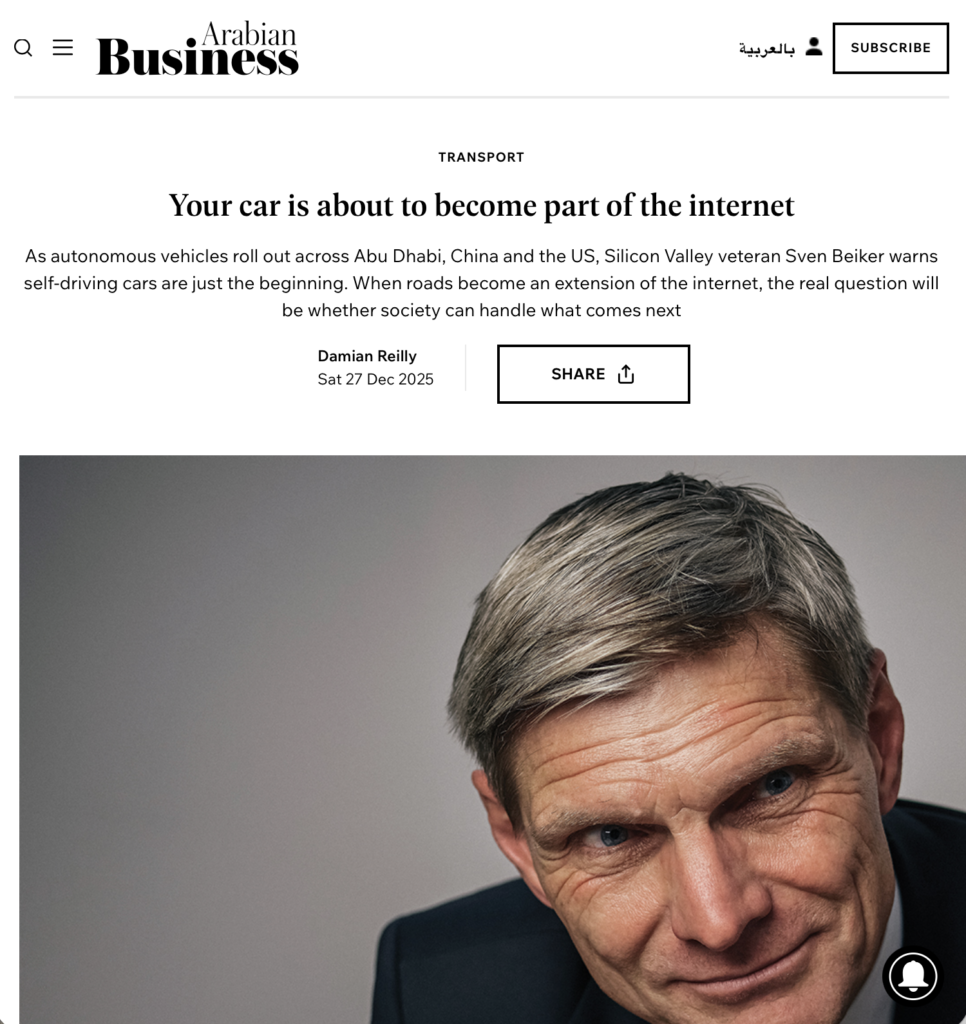
In my conversation with Damian Reilly the Arabian Business, we talked about how cars are rapidly becoming part of the internet — and how that shift goes well beyond just autonomy on the roads. I explained that as vehicles get smarter and increasingly connected with infrastructure, other cars, and digital services, our entire transportation system is evolving into a distributed network rather than a collection of isolated machines. 

I stressed that self-driving technology is only the beginning: the real transformation will come when vehicles exchange data with cities, traffic systems, and each other to optimise flow, safety and efficiency. That raises big questions — not just technical ones about connectivity and platforms, but societal ones about privacy, regulation and whether we’re ready for this level of digital integration. 

I also shared my perspective that while this connectivity has huge potential benefits — from fewer accidents to new mobility services — we need to think carefully about the implications for jobs, urban planning and how we govern these systems as they become an extension of the internet itself.

Robotaxis will come to Sweden, to Europe! What does that mean?

Robotaxis will come to Sweden, to Europe! What does that mean?

Nice coverage from Vinnova’s Future Mobility here on Ingrid Skogsmo’s and my presentation at the 2025 Drive Sweden Forum:

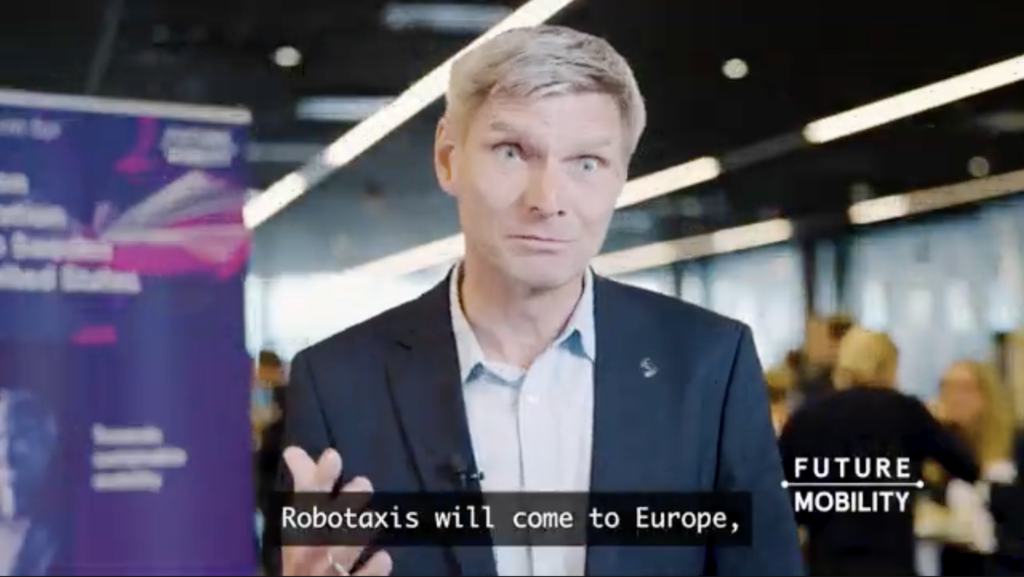
“Robotaxis will come to Sweden, to Europe! What does that mean? We don’t want to be overrun by yet another advanced mobility solution. We want to be prepared.” – Sven Beiker, Silicon Valley Mobility.

To build the competence and readiness needed for a large-scale robotaxi implementation in Sweden and Europe, Vinnova, via Future Mobility, has funded the project “Learning for Deployment of Robotaxis at Scale.”

The project was conducted by Ingrid Skogsmo (Ph.D.h.c.), ( Swedish National Road and Transport Research Institute (VTI)), and Sven Beiker, PhD (Silicon Valley Mobility), with support from Pony.ai and Zeekr Technology Europe. The research draws on extensive international mapping, interviews with stakeholders across the United States, China, Europe, and Sweden, and focus group discussions with citizens in California.

The project identified key lessons that can inform future implementations in Europe.

Attending the Abu Dhabi Autonomous Summit

Attending the Abu Dhabi Autonomous Summit

Attending the أبوظبي للأنظمة ذاتية الحركة | Abu Dhabi Autonomous Summit 2025 offered me an impressive look at how the UAE — and Abu Dhabi in particular — are positioning themselves in the rapidly evolving global landscape of autonomous mobility across land, air, and sea.

What became clear throughout the summit is that the UAE is not trying to compete with the Europe🇪🇺, USA🇺🇸, or China🇨🇳 on their terms — it is carving out its own distinct niche defined by speed, clarity of vision, and strategic alignment between public and private sectors. A few examples:

🚀 A global benchmark-setter, not a follower
In their opening remarks, officials stated they are “not waiting for international standards — but setting benchmarks.” This positions the UAE as a place where global players can test, deploy, and refine technologies alongside evolving regulatory frameworks, rather than waiting for them to catch up.

⚙️ A deployment-focused alternative to the major innovation hubs
While the USA is strong in research, Europe in safety and industrial excellence, and China in scale, Abu Dhabi emphasizes deployment speed. Processes that take months elsewhere can be completed in weeks, creating a compelling environment for companies seeking real-world pilots, not just pilots on paper.

🛠️ From technology buyer to technology builder
Through strategic clusters like SAVI | Smart & Autonomous Vehicle Industry, Abu Dhabi is evolving into a creator of technology — a complementary pole to established innovation ecosystems in Silicon Valley, Shenzhen, and Europe’s automotive heartlands.

🤝 A governance model based on co-creation
The UAE highlights a regulatory philosophy built on collaboration, in which the private sector is the driver and the public sector the enabler, integrating agility with a strong emphasis on safety and public trust.

📊 Measured risk-taking as an economic asset
The UAE describes itself as a “sandbox of the world” — not because risk is ignored, but because risks are identified, mitigated, and managed. This enables innovation to keep pace with forward-looking regulation, a balance that is increasingly essential for global competitiveness.

🚁 A multi-modal vision of autonomy
From autonomous vehicles to maritime systems to more than 10 planned or operational vertiports, the UAE’s goal of 25% autonomous mobility by 2040 reflects a holistic and integrated mobility strategy.

🇦🇪 A diversified, talent-driven economy
Reducing petroleum dependency from 80% to 43% is not just an economic statistic — it signals a shift toward future industries supported by on-site talent, venture investment, and strong leadership.

Ex-BMW Exec Exposes The Reality of Electric Autonomous Vehicles

Ex-BMW Exec Exposes The Reality of Electric Autonomous Vehicles

I recently had a interview on The Fleet where I joined Chris Brandt to unpack the state of electric and autonomous vehicles — especially as they relate to commercial fleets. It’s a good moment to step back from the hype and look at what’s real and what’s still work in progress.

There are two key takeaways that I think matter for the mobility community today:
First, electrification is progressing fast, but infrastructure and ecosystem readiness — from reliable charging to power capacity — still lag the vehicle capabilities. The car can be electric, but the environment around it often isn’t yet mature enough for seamless operations.

Second, autonomous driving isn’t a single technological milestone that suddenly switches on. Instead, we see gradual advancements in specific domains — especially in controlled fleet operations such as shuttles, delivery, and logistics. These use cases provide structured routes and repeatable conditions where autonomy can be deployed safely and incrementally.

If you’re following mobility trends closely, this interview is worth a listen: it goes beyond headlines and looks at systems readiness, real use cases, and what comes next.

Upcoming talk and workshop at Mobility Startup Day

Upcoming talk and workshop at Mobility Startup Day

Those of you who like to hear me without an accent, here is a nice video announcing my talk and workshop at the Mobility Startup Day in Braunschweig, Germany on Dec 2. Well, it is all in German, but you all know the tricks and tweaks how to turn this into your preferred communication patterns.

And maybe you will even be able to join me on Dec 2 in Braunschweig, das würde mich sehr freuen…

Click the image on the right to watch the video (in German).

New academic appointment: teaching and researching AI in corporate operations

New academic appointment: teaching and researching AI in corporate operations

I am excited to announce my new academic appointment (in addition to my now 15-year long assignment at the Stanford Business School):

Thanks very much to my colleagues at the University of Borås for welcoming me to their school and giving me the opportunity to apply my experience to artificial intelligence and small and medium-sized enterprises. In my teaching and research there, I am looking at how product development can benefit from AI, with a particular focus on SMEs.

And to those of you wondering whether I am abandoning my long-term passion for automotive & mobility topics: Not at all!!! This assignment in Borås is a great opportunity to apply my industry background to teaching and research in a field where so much is happening at the moment. As I strive to keep up with the trends in industry, here it is about SMEs, the backbone of the economy, including the automotive field.

See the link on the right to read the interview with the university’s media team.


Conference interview: discussing standards and regulation

Conference interview: discussing standards and regulation

Recently, I have gotten more involved in regulatory and standardization matters around automated vehicles. Now I am looking forward to my participation on behalf of SAE International in the panel discussion “Where standards and regulations meet – how can they best interact?” at the ADAS & AV Conference in San Jose, CA.

Prior to that panel, the conference organizers at UKi Media & Events sat down with me for an interview related to that topic.

The points that were most important for me to get across in that interview:

Industry has a love-hate relationship with standards, but they facilitate collaboration and compare your product with an industry baseline.

  • Industry has a love-hate relationship with standards, but they facilitate collaboration and compare your product with an industry baseline.
  • Regarding regulation, there are important distinctions between type-approval (Europe, Japan, South Korea) and self-certification (U.S.).
  • Quite often, regulation references standards. For example, the U.S. Federal Motor Vehicle Safety Standards frequently reference SAE standards.

See the link on the right to read the full interview. What do you think?


Book event at the Stanford Research Park – April 13, 2023

Book event at the Stanford Research Park – April 13, 2023

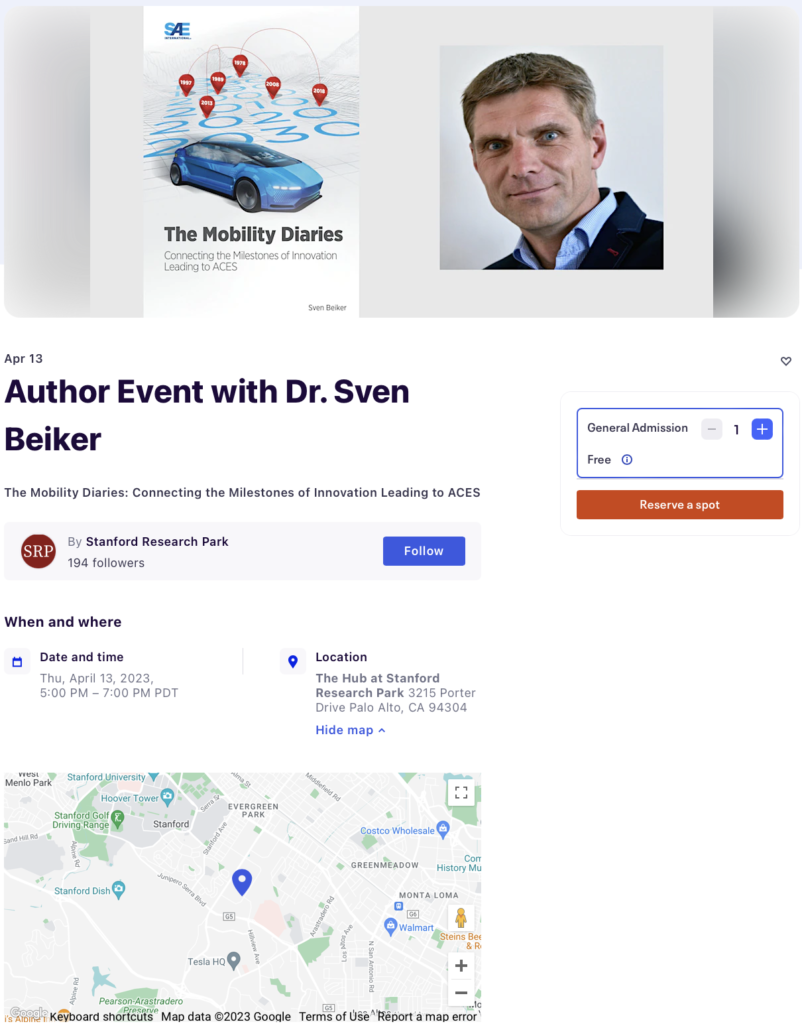
Mark your calendars – we are having a networking event to discuss my book The Mobility Diaries on April 13, 5pm at Stanford Research Park. This is an in-person event open to the public.

Here’s the program (or visit event page):
5:00 Reception, early guests will get a free book
5:30 “The Mobility Diaries” – A conversation with Dr. Sven Beiker
6:15 Book signing and networking

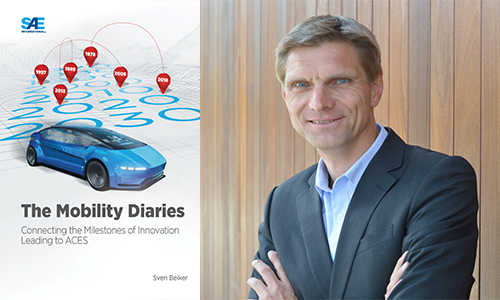
The Mobility Diaries, published by SAE International, tell my view of how autonomous, connected, electric, and shared vehicles have come about. Now I look forward to a good discussion and am eager to get your take on the matter.

Registration is now open at: https://www.eventbrite.com/e/author-event-with-dr-sven-beiker-tickets-575687134717

See you there!

SAE International Blog about The Mobility Diaries

SAE International Blog about The Mobility Diaries

Thank you SAE International for blogging about my new book, The Mobility Diaries: https://www.sae.org/blog/meet-the-author-sven-beiker

It summarizes the interview we did not too long ago when I shared how the idea for the book came about, why it is important to me to connect the past – present – future of mobility, and how Detroit and Silicon Valley need one another.

Read more in the blog, or better yet, buy the book!
http://themobilitydiaries.com

The Mobility Diaries – Podcast Interview with the SAE Publishers

The Mobility Diaries – Podcast Interview with the SAE Publishers

Meet the Author: The Mobility Diaries: Connecting the Milestones of Innovation Leading to ACES

Watch the Sep 2022 interview featuring Shane Bialowas, Angela Kenner, and & Sven Beiker, discussing his new book. In The Mobility Diaries he opens up his personal diary regarding his take on 50 years of mobility innovation and history interwoven with his experiences in the automotive and mobility industries including autonomous driving, connectivity, electrification, and shared mobility.

New book coming out – Meet the Author event with SAE Publishers

New book coming out – Meet the Author event with SAE Publishers

So we are getting real: My book “The Mobility Diaries” is now finally coming out. Join us on September 21 for a “Meet the Author” online session hosted by SAE International, my publisher.

Here’s a bit more about the book:
Sven Beiker is specializing in future trends for the automotive and mobility industries including autonomous driving, connectivity, electrification, and shared mobility. In “The Mobility Diaries: Connecting the Milestones of Innovation Leading to ACES”, he opens up his personal diary regarding his take on 50 years of mobility innovation and history interwoven with his experiences from 1978 to 2018.

From the Foreword by Reilly Brennan: “Understanding how transportation itself evolved requires a unique prism. The core components of vehicles today have stories and engineering journeys worth their own telling, and that is what is so exciting about the way we can learn about them in this text. Dr. Beiker’s curriculum vitae, from BMW to Stanford University to McKinsey, are a compendium of experiences that created this unique historical and biographical book.”

“Sven and I are kindred spirits in the mobility world. His view on the evolution of mobility and technology illustrates why Detroit and Silicon Valley need one another.” Carla Bailo, Former President and CEO, Center for Automotive Research

The book can be purchased at SAE International right away and soon everywhere where you can buy books.

Smart Sensors – Interview with Sensors Converge

Smart Sensors – Interview with Sensors Converge

This was already in June but it still makes for a good discussion of smart sensors: my interview at the Sensors Converge 2022.

People are putting more and more intelligence into sensors – which we call smart sensors. Traditionally, sensors used to be a device to measure exactly one thing. But now much more intelligence is going into it and it’s going to become more and more miniaturized, which is pretty incredible. They are talking about what used to be a system on a chip (SOC) is now a system in a sensor…

SAE’s Sven Beiker to chair the session on smart sensors and sensor fusion at Sensors Converge 2022

SAE’s Sven Beiker to chair the session on smart sensors and sensor fusion at Sensors Converge 2022

(originally published by SAE International on June 13, 2022 at https://www.sae.org/blog/sensors-converge-beiker)

Dr. Sven Beiker, Managing Director of Silicon Valley Mobility and External Advisor for SAE International, will chair a session at the upcoming Sensors Converge conference June 27-29 in San Jose, California.

The session, called Smart Sensors & Sensor Fusion, will provide a day-long insights for to understand new developments in the sensors space. Speakers on the track will cover sensor market growth, testing, software trends, safety requirements and more.

The conference got its start 37 years ago with a focus on sensor technology and has grown and diversified throughout the years to include the electronics technologies and embedded systems that work together with sensors as well as emerging application areas.

“The conference has an excellent reputation in the industry for bringing key players together to discuss important technologies that drive innovation,” Dr. Beiker said. “I’m looking forward to the conversations that will happen at this year’s event.”

Register for Sensors Converge on their website.

PAVE Panel on ODD – The Question is Where not When!

PAVE Panel on ODD – The Question is Where not When!

Carter Stern of Cruise and I had a great discussion on Operational Design Domains (ODDs) for automated vehicles at the Partners for Automated Vehicle Education (PAVE) panel.

Our overarching theme was “Where, Not When: Why Domains Matter” and it was nice that Carter and I could build off of one another’s perspectives from the tech and auto industries.

Here’s one of my key points:
An Operational Design Domain can be anything. It can be what is sometimes called the ‘Four Ws’ – wherever, whenever, whatever the weather. And that is what is called ‘level 5’ or all ODDs you can imagine. But level 5 driving is similar to infinity in math: it is important to prove your concept, but you never get there.”

Tabitha Colter did a fantastic job moderating the discussion and putting thoughtful questions in front of us. Thanks very much!

Webcast with SAE on the mobility topics of 2021

Webcast with SAE on the mobility topics of 2021

I had a very nice conversation with Angela Kenner at SAE International when we discussed the trends in automated driving and electric mobility of 2021 and where things might be going next year.

We started out with some observations in China and then moved to Silicon Valley.

Certainly, much has been accomplished with AVs and EVs, especially where strong partnerships between the traditional automotive industry, tech players, and startups thrive.

An easy listening, I hope you like it.

Happy holidays everyone, we’ll reconnect in 2022…

Realities of traffic make automated driving a challenge

Realities of traffic make automated driving a challenge

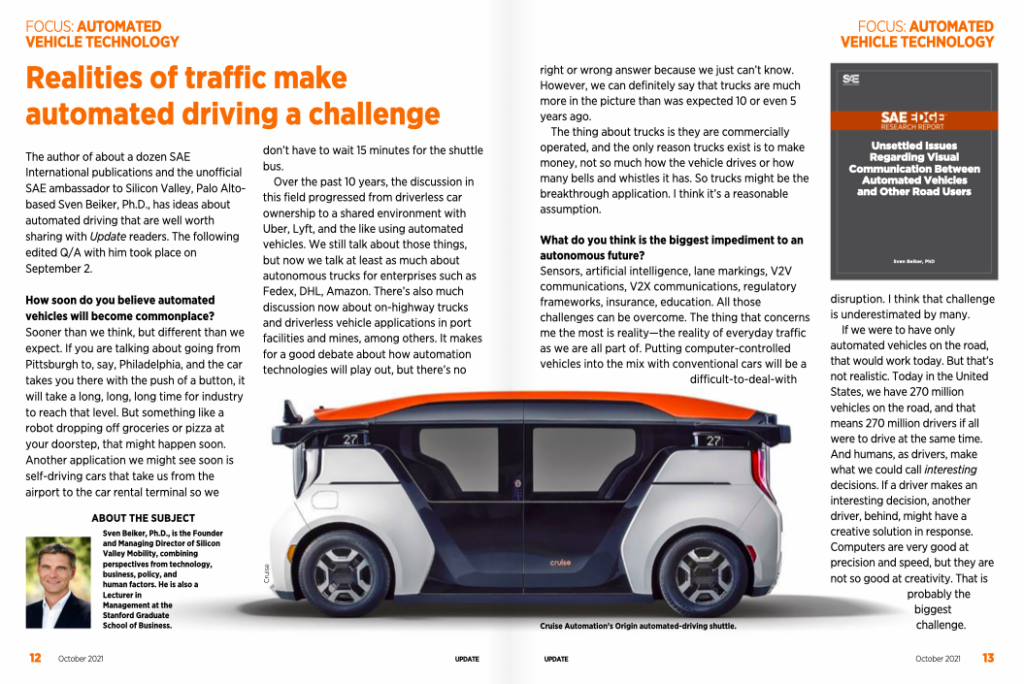
Nice interview here with SAE International for their monthly magazine “Update“. My piece is titled “Realities of traffic make automated driving a challenge”.

It is a conversation around what is missing to bring autonomous vehicles (automated driving to use the right SAE term) to the real world. I am glad that SAE asked as I have been discussing a lot over the years what is holding us back: technology, regulation, trust…? My view is that we have solutions for all of those, as long as we choose the ODD wisely. However, real-world traffic still poses the biggest challenge.

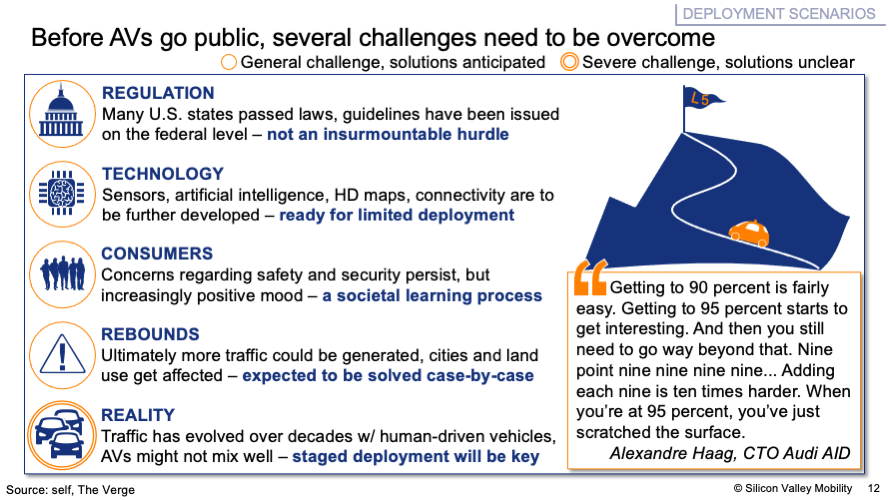
Along those lines, I created the following chart at some point. On the right you see the graphic of climbing a mountain, which I typically use as a prompt in my talks to say the following.

– If you want to get on top of the world, Mount Everest, you might get on a plane in San Francisco, make a connection in Heathrow, and get to Kathmandu.
– From the airport you travel to the basecamp at 5,300m altitude of Mount Everest
– At that point you have traveled well over 99% or so of the distance, but this is where it begins to get interesting…

Future of Mobility – virtual fireside chat w/ Mario Herger

Future of Mobility – virtual fireside chat w/ Mario Herger

Mario Herger and Sven Beiker discussed different viewpoints on the combined effect of autonomous driving, electric vehicles, and the sharing economy.

We are on the verge of changing our life as we know it. The way people get around today won’t be recognizable by 2030 – and the impact will be huge. Vehicles will increasingly drive themselves, powered by renewable electric energy, connected via ultra-fast data networks, and shared via mobility platforms. While many agree that those are the directions into the future of mobility, there is still some disagreement regarding the speed at which we are moving in those directions.

Some say that the driver’s license will soon be a thing of the past, others point out that things take time given inertia in the industry, market, and regulation. Those different viewpoints make for a great discussion among the two experts for a virtual fireside chat hosted by GABA – German American Business Association on May 26, 2020.

Silicon Valley Mobility Chart of the Month, Jan 2020

Silicon Valley Mobility Chart of the Month, Jan 2020

Here we are in 2020 and where are the flying cars and where are the self-driving automobiles? At the beginning of a new decade I review my own forecasts from the past 10+ years and highlight things I got right and those that were a bit off. I also recommend that “forecasting” should rather be done as “projections”, i.e. one is at some point in time now and projects into the future. This should be done in different categories, such as events / innovations that are “certain”, “probable”, or simply just “possible” to happen. Either way, this makes for a interesting self-reflection that I can only recommend to everyone in the field of new mobility and future thinking. It is always good to look back “… what was I thinking?!” I hope you agree this deserves a 7:42 min video. Let me know what you think…

Mobility Outlook 2020 – Interview w/ Mario Herger

Mobility Outlook 2020 – Interview w/ Mario Herger


Sven Beiker of Silicon Valley Mobility and Mario Herger met again for a short mobility talk at the beginning of 2020 and analyzed the current situation.

Topics we discussed included:

  • Autonomous driving in 2020
  • Tesla share: still just a hype?
  • Tesla Gigafactory 3 & 4
  • Future of traditional car makers

Chart of the Month 2018/01 – Interview w/ Mario Herger

Chart of the Month 2018/01 – Interview w/ Mario Herger

Chart of the Month by Silicon Valley Mobility for January 2018 – infrastructure requirements for advanced mobility and funding gap

The last half year of the chart of the month (07-12/2017) covered the individual trends autonomous, connected, electrified, and shared mobility. The question was often asked, what is missing to move forward in those categories toward a scenario of self-driving, fully connected, all-electric, and conveniently shared vehicles.

The answer is “infrastructure!”, which this month’s chart summarizes. There are 3 categories of infrastructure needed in mobility:
(1) the cvil or built infrastructure with roads, traffic signs
(2) the tech infrastructure with communication and charge networks
(3) the legal infrastructure with permits, standards, taxation

The challenge however is that infrastructure is largely underfunded in many countries; in the U.S. less than half of the existing needs (mostly building and repairing the current roads and bridges…) are covered. That poses big challenges and public-private partnerships are needed to move forward on the agenda for advanced mobility.

© 2017-2026 - Silicon Valley Mobility, LLC 1102 Clark Way, Palo Alto, CA 94304, USA