Interview: Self-driving cars are spreading across U.S. cities. Are they safe?

Interview: Self-driving cars are spreading across U.S. cities. Are they safe?

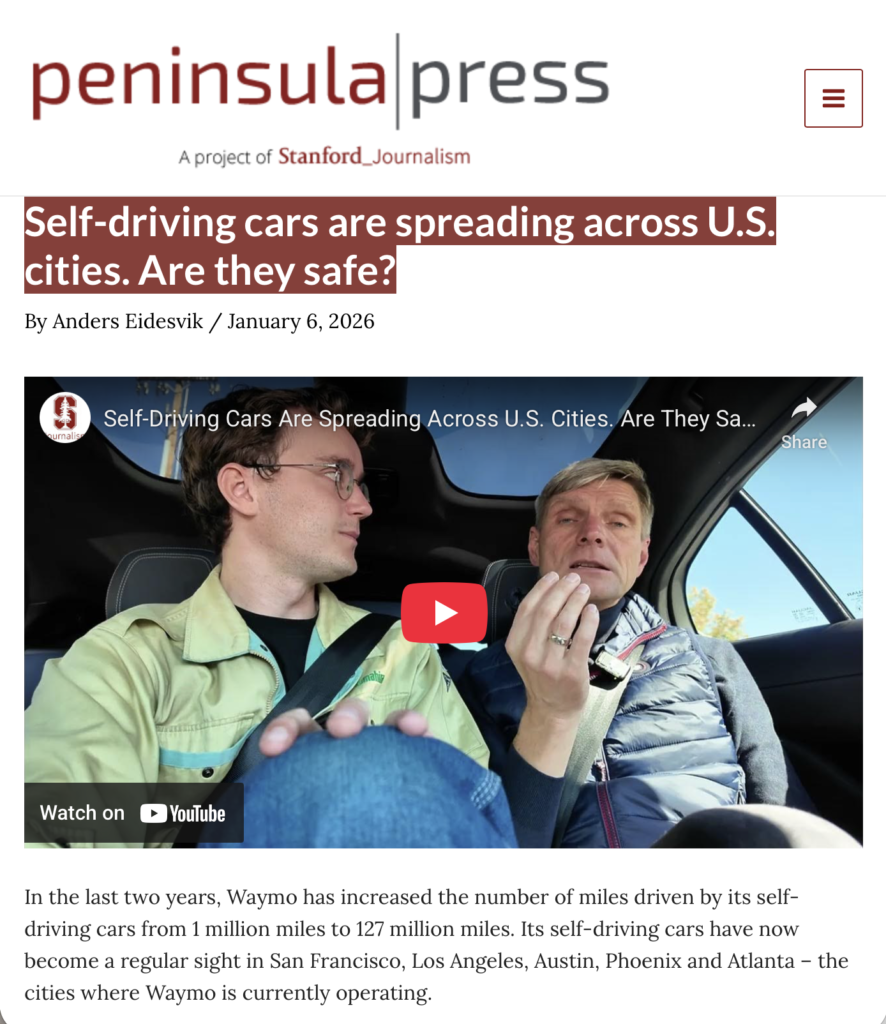
Here’s a nice video interview where I discuss how robotaxis work, why they are the better drivers, and where things are going – and all that while riding in a Waymo.

When I spoke with Anders Eidesvik for Peninsula Press, we focused on how quickly robotaxis are becoming normal in U.S. cities — and whether they’re actually safer. I pointed out that Waymo alone has already logged well over 100 million miles, which finally gives us meaningful safety data instead of just promises.

What those numbers show is pretty clear: these vehicles crash less often than humans and most incidents don’t even lead to injuries. A big reason is their sensor stack — lidar, radar, cameras — plus the fact that they don’t get tired, distracted, or overconfident like people do.

That said, I also stressed that widespread adoption will take time. Waymo is ahead, but others like Tesla and Zoox are still developing their systems, and fully autonomous cars outnumbering human drivers is probably decades away, not right around the corner.

Interview: Your car is about to become part of the internet

Interview: Your car is about to become part of the internet

In my conversation with Damian Reilly the Arabian Business, we talked about how cars are rapidly becoming part of the internet — and how that shift goes well beyond just autonomy on the roads. I explained that as vehicles get smarter and increasingly connected with infrastructure, other cars, and digital services, our entire transportation system is evolving into a distributed network rather than a collection of isolated machines. 

I stressed that self-driving technology is only the beginning: the real transformation will come when vehicles exchange data with cities, traffic systems, and each other to optimise flow, safety and efficiency. That raises big questions — not just technical ones about connectivity and platforms, but societal ones about privacy, regulation and whether we’re ready for this level of digital integration. 

I also shared my perspective that while this connectivity has huge potential benefits — from fewer accidents to new mobility services — we need to think carefully about the implications for jobs, urban planning and how we govern these systems as they become an extension of the internet itself.

Robotaxis will come to Sweden, to Europe! What does that mean?

Robotaxis will come to Sweden, to Europe! What does that mean?

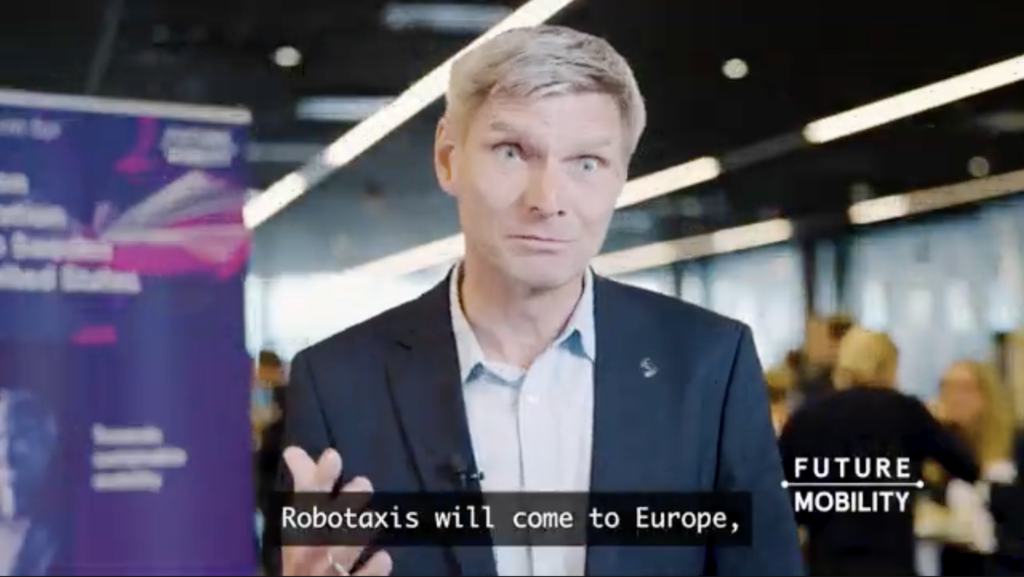
Nice coverage from Vinnova’s Future Mobility here on Ingrid Skogsmo’s and my presentation at the 2025 Drive Sweden Forum:

“Robotaxis will come to Sweden, to Europe! What does that mean? We don’t want to be overrun by yet another advanced mobility solution. We want to be prepared.” – Sven Beiker, Silicon Valley Mobility.

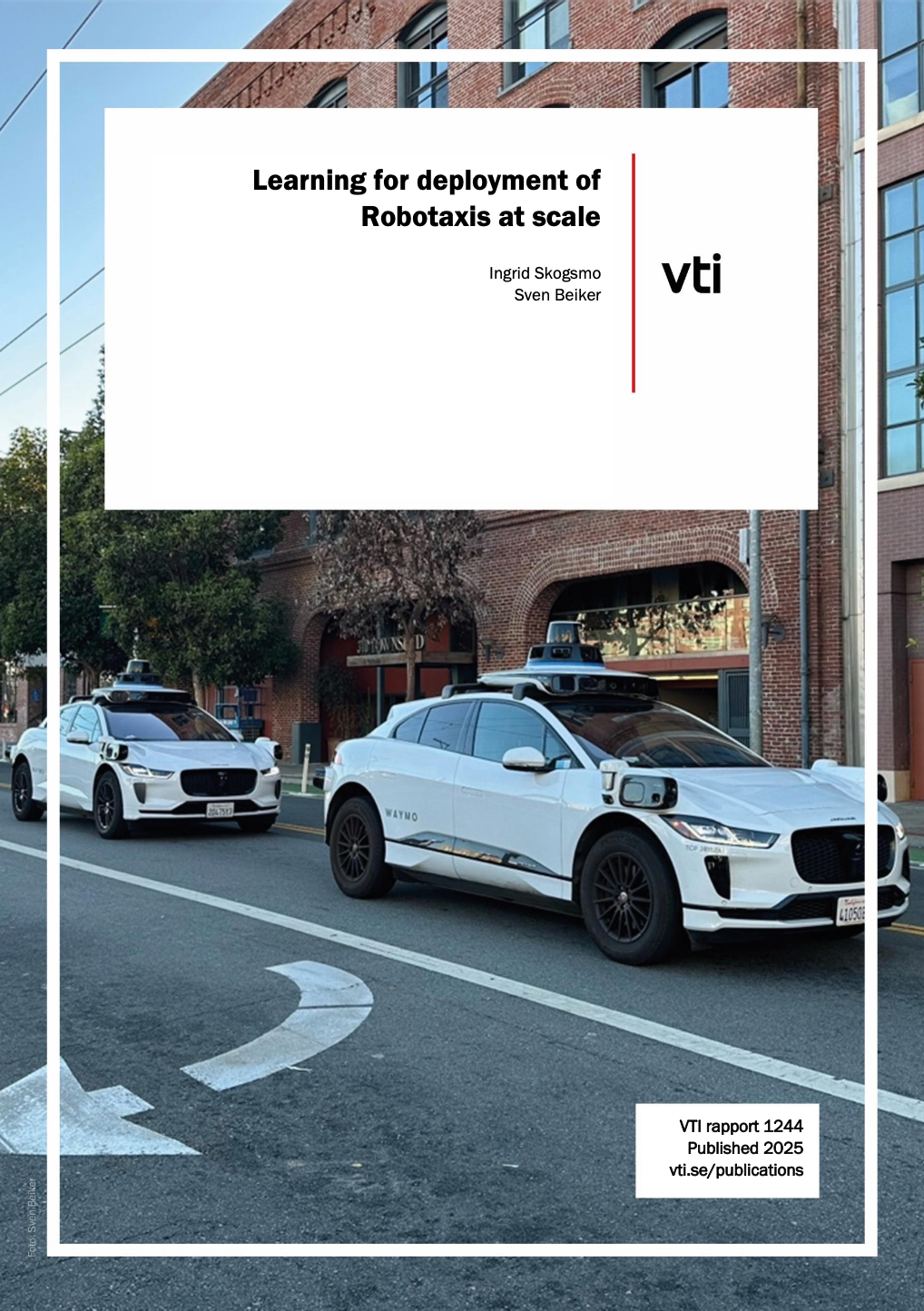
To build the competence and readiness needed for a large-scale robotaxi implementation in Sweden and Europe, Vinnova, via Future Mobility, has funded the project “Learning for Deployment of Robotaxis at Scale.”

The project was conducted by Ingrid Skogsmo (Ph.D.h.c.), ( Swedish National Road and Transport Research Institute (VTI)), and Sven Beiker, PhD (Silicon Valley Mobility), with support from Pony.ai and Zeekr Technology Europe. The research draws on extensive international mapping, interviews with stakeholders across the United States, China, Europe, and Sweden, and focus group discussions with citizens in California.

The project identified key lessons that can inform future implementations in Europe.

Attending the Abu Dhabi Autonomous Summit

Attending the Abu Dhabi Autonomous Summit

Attending the أبوظبي للأنظمة ذاتية الحركة | Abu Dhabi Autonomous Summit 2025 offered me an impressive look at how the UAE — and Abu Dhabi in particular — are positioning themselves in the rapidly evolving global landscape of autonomous mobility across land, air, and sea.

What became clear throughout the summit is that the UAE is not trying to compete with the Europe🇪🇺, USA🇺🇸, or China🇨🇳 on their terms — it is carving out its own distinct niche defined by speed, clarity of vision, and strategic alignment between public and private sectors. A few examples:

🚀 A global benchmark-setter, not a follower
In their opening remarks, officials stated they are “not waiting for international standards — but setting benchmarks.” This positions the UAE as a place where global players can test, deploy, and refine technologies alongside evolving regulatory frameworks, rather than waiting for them to catch up.

⚙️ A deployment-focused alternative to the major innovation hubs
While the USA is strong in research, Europe in safety and industrial excellence, and China in scale, Abu Dhabi emphasizes deployment speed. Processes that take months elsewhere can be completed in weeks, creating a compelling environment for companies seeking real-world pilots, not just pilots on paper.

🛠️ From technology buyer to technology builder
Through strategic clusters like SAVI | Smart & Autonomous Vehicle Industry, Abu Dhabi is evolving into a creator of technology — a complementary pole to established innovation ecosystems in Silicon Valley, Shenzhen, and Europe’s automotive heartlands.

🤝 A governance model based on co-creation
The UAE highlights a regulatory philosophy built on collaboration, in which the private sector is the driver and the public sector the enabler, integrating agility with a strong emphasis on safety and public trust.

📊 Measured risk-taking as an economic asset
The UAE describes itself as a “sandbox of the world” — not because risk is ignored, but because risks are identified, mitigated, and managed. This enables innovation to keep pace with forward-looking regulation, a balance that is increasingly essential for global competitiveness.

🚁 A multi-modal vision of autonomy
From autonomous vehicles to maritime systems to more than 10 planned or operational vertiports, the UAE’s goal of 25% autonomous mobility by 2040 reflects a holistic and integrated mobility strategy.

🇦🇪 A diversified, talent-driven economy
Reducing petroleum dependency from 80% to 43% is not just an economic statistic — it signals a shift toward future industries supported by on-site talent, venture investment, and strong leadership.

Ex-BMW Exec Exposes The Reality of Electric Autonomous Vehicles

Ex-BMW Exec Exposes The Reality of Electric Autonomous Vehicles

I recently had a interview on The Fleet where I joined Chris Brandt to unpack the state of electric and autonomous vehicles — especially as they relate to commercial fleets. It’s a good moment to step back from the hype and look at what’s real and what’s still work in progress.

There are two key takeaways that I think matter for the mobility community today:
First, electrification is progressing fast, but infrastructure and ecosystem readiness — from reliable charging to power capacity — still lag the vehicle capabilities. The car can be electric, but the environment around it often isn’t yet mature enough for seamless operations.

Second, autonomous driving isn’t a single technological milestone that suddenly switches on. Instead, we see gradual advancements in specific domains — especially in controlled fleet operations such as shuttles, delivery, and logistics. These use cases provide structured routes and repeatable conditions where autonomy can be deployed safely and incrementally.

If you’re following mobility trends closely, this interview is worth a listen: it goes beyond headlines and looks at systems readiness, real use cases, and what comes next.

Report: Learning for Deployment of Robotaxis at Scale

Report: Learning for Deployment of Robotaxis at Scale

I am proud to share the results of a great collaboration with Ingrid Skogsmo, Pony.ai, and Zeekr Technology Europe now published in the report “Learning from the Deployment of Robotaxis at Scale.” This project was funded by Vinnova in conjunction with Future Mobility.

We discuss large-scale robotaxi operations, primarily in California and China, and point out the lessons learned that should help greatly to anticipate future deployments in other places (Europe and Sweden in particular) in the pursuit of sustainability, safety, and equality. All this is easier said than done, which we realized in several cases and write about in the report.

The insights should be of interest to anyone in automated driving, shared mobility, public transport, policy development, or industry strategies.

I look forward to your thoughts and feedback. Feel free to comment or reach out directly if you’d like to discuss the findings and their implications.


Upcoming talk and workshop at Mobility Startup Day

Upcoming talk and workshop at Mobility Startup Day

Those of you who like to hear me without an accent, here is a nice video announcing my talk and workshop at the Mobility Startup Day in Braunschweig, Germany on Dec 2. Well, it is all in German, but you all know the tricks and tweaks how to turn this into your preferred communication patterns.

And maybe you will even be able to join me on Dec 2 in Braunschweig, das würde mich sehr freuen…

Click the image on the right to watch the video (in German).

Conference interview: discussing standards and regulation

Conference interview: discussing standards and regulation

Recently, I have gotten more involved in regulatory and standardization matters around automated vehicles. Now I am looking forward to my participation on behalf of SAE International in the panel discussion “Where standards and regulations meet – how can they best interact?” at the ADAS & AV Conference in San Jose, CA.

Prior to that panel, the conference organizers at UKi Media & Events sat down with me for an interview related to that topic.

The points that were most important for me to get across in that interview:

Industry has a love-hate relationship with standards, but they facilitate collaboration and compare your product with an industry baseline.

  • Industry has a love-hate relationship with standards, but they facilitate collaboration and compare your product with an industry baseline.
  • Regarding regulation, there are important distinctions between type-approval (Europe, Japan, South Korea) and self-certification (U.S.).
  • Quite often, regulation references standards. For example, the U.S. Federal Motor Vehicle Safety Standards frequently reference SAE standards.

See the link on the right to read the full interview. What do you think?


Report on traditional automotive industry and new mobility players

Report on traditional automotive industry and new mobility players

I am proud to have my latest publication with SAE International out:
TWO APPROACHES TO MOBILITY ENGINEERING

This topic is very dear to my heart: to compare and contrast the traditional automotive industry and the new mobility players. Too often have I been getting questions like “who will win?” or “don’t you agree that the metal benders are just dinosaurs that don’t get it?”. Well, the answers are “tough to tell” and “no” and it was about time to write a whole report about the evolution of this fascinating industry.

Here’s the abstract, and see the link on the right for the whole report:
What are the differences between the traditional automotive companies and “new mobility” players—and even more importantly, who will win? Those are the questions that this report discusses, taking a particular focus on engineering aspects in the automotive/mobility sector and addressing issues regarding innovation, business, market, and regulation. To find answers to the questions raised, nearly 20 industry experts from new and established companies were interviewed to gain an overview of the intricacies of newcomers and incumbents, to see where the industry stands, and to provide an outlook on where the sector is headed. This is rounded out by recommendations as to what respective players should do to master their future and stay at the forefront of mobility innovation.


Report on Next-generation Sensors for Automated Road Vehicles

Report on Next-generation Sensors for Automated Road Vehicles

I am proud to announce that I published another SAE International report in the field of automated vehicles. This one is titled Next-generation Sensors for Automated Road Vehicles

It is essentially the follow-up to the 2018 inaugural SAE EDGE Research Report on Unsettled Topics Concerning Sensors for Automated Road Vehicles and reviews the progress made in automated vehicle sensors over the past four to five years. We also discuss persistent disagreement and confusion regarding certain terms for describing sensors (near-/mid-/long-range, “bad weather”, …), the different strengths and shortcomings of particular sensors (camera, radar, LiDAR), and procedures regarding how to specify and evaluate them (test procedures, evaluation, comparison…).

All in all, “Next-gen Automated Road Vehicle Sensors” summarizes current trends and debates (e.g., sensor fusion, embedded AI, simulation) as well as future directions and needs.


Report on Energy Options on the Path Toward a More Sustainable Transportation Sector

Report on Energy Options on the Path Toward a More Sustainable Transportation Sector

I just published another SAE International report, this time related to sustainability in transportation: Energy Options on the Path Toward a More Sustainable Transportation Sector

The transportation sector has an enormous demand for resources and energy, is a major contributor of emissions (i.e., greenhouse gases in particular), and it is defined largely by the kind of energy it uses—be it electric cars, biofuel trucks, or hydrogen aircraft. Given the size of this sector, it has a crucial role in combatting climate change and securing sustainability in its three forms: environmental, societal, and economic. 

Energy Options on the Path Toward a More Sustainable Transportation Sector examines the many questions concerning alternative energy options for mobility: 

  • Is hydrogen the fuel of the future?
  • Is there is enough electricity to power a fully electric transportation sector?
  • What happens when millions of electric vehicle batteries need to be decommissioned?
  • Which regulatory measures are effective and appropriate for moving the sector in the right direction?
  • What is the “right” direction?


Realities of traffic make automated driving a challenge

Realities of traffic make automated driving a challenge

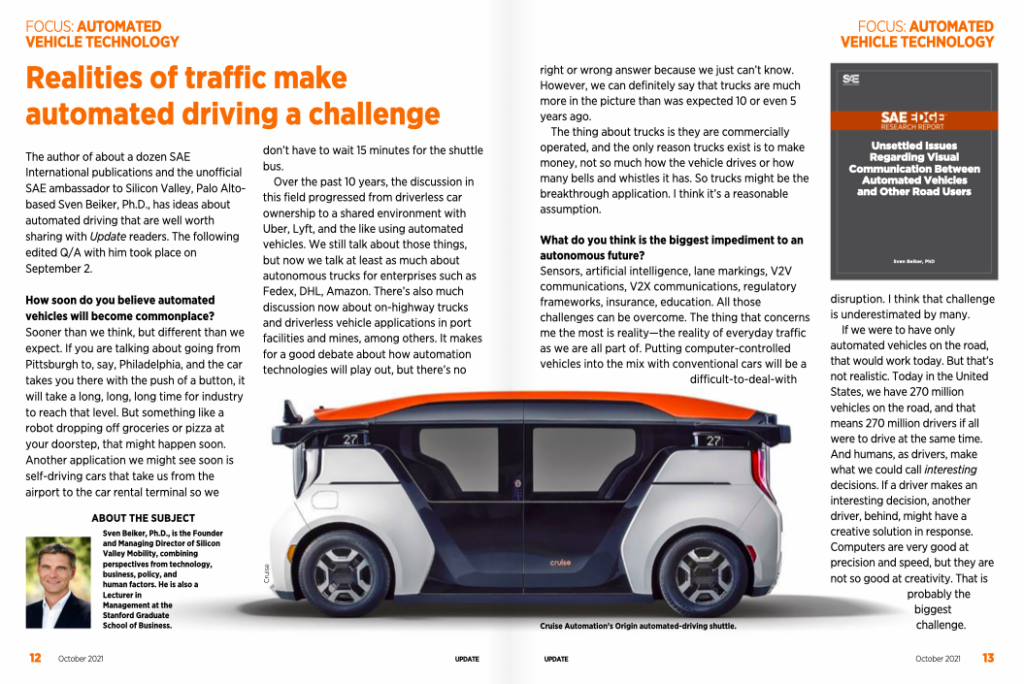
Nice interview here with SAE International for their monthly magazine “Update“. My piece is titled “Realities of traffic make automated driving a challenge”.

It is a conversation around what is missing to bring autonomous vehicles (automated driving to use the right SAE term) to the real world. I am glad that SAE asked as I have been discussing a lot over the years what is holding us back: technology, regulation, trust…? My view is that we have solutions for all of those, as long as we choose the ODD wisely. However, real-world traffic still poses the biggest challenge.

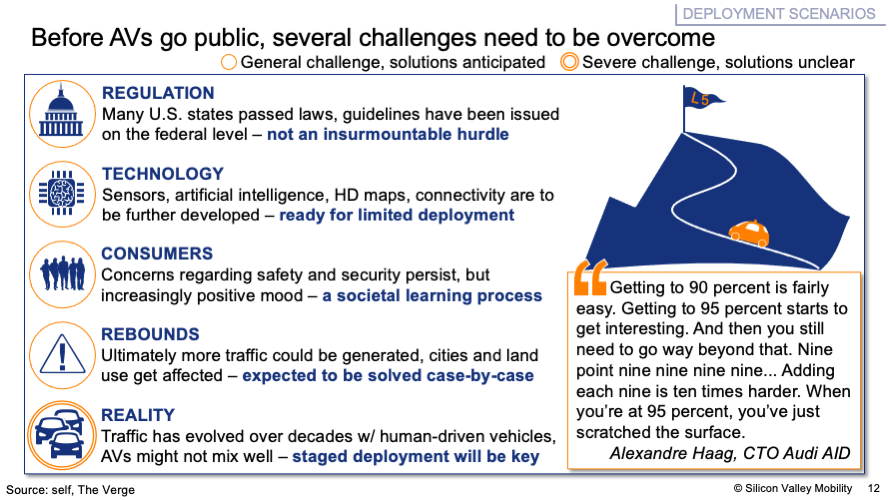
Along those lines, I created the following chart at some point. On the right you see the graphic of climbing a mountain, which I typically use as a prompt in my talks to say the following.

– If you want to get on top of the world, Mount Everest, you might get on a plane in San Francisco, make a connection in Heathrow, and get to Kathmandu.
– From the airport you travel to the basecamp at 5,300m altitude of Mount Everest
– At that point you have traveled well over 99% or so of the distance, but this is where it begins to get interesting…

Report on Visual Communication Between Automated Vehicles and Other Road Users

Report on Visual Communication Between Automated Vehicles and Other Road Users

I am glad and proud to have another SAE EDGE Research Report published. This one discusses “Visual Communication Between Automated Vehicles and Other Road Users”.

As automated road vehicles begin their deployment into public traffic, they will need to interact with human driven vehicles, pedestrians, bicyclists, etc. This requires some form of communication between those automated vehicles (AVs) and other road users. Some of these communication modes (e.g., auditory, motion) were previously addressed in “Unsettled Issues Regarding Communication of Automated Vehicles with Other Road Users.”

We had the general overview already out earlier in the year, and now this one focuses on visual communication and its balance of reach, clarity, and intuitiveness, and discusses how different visual modes (e.g., simple lights, rich text) can be used between AVs and other road users. A particular emphasis is put on standardization to highlight how uniformity and mass adoption increase communication efficacy.

Road Vehicle Automation Vol 8 is out

Road Vehicle Automation Vol 8 is out

Happy to report that the 8th volume of Road Vehicle Automation is out! Year after year I am enjoying the collaboration with Gereon Meyer on this book, and reading the papers before we forward them for publication helps me tremendously to stay current in the field of driving automation.

Thanks to all the great authors for letting me learn from you!

Alright, more to come, ARTS21 (Automated Road Transportation Symposium) is starting on Jul 12 and soon after Gereon and I will start Road Vehicle Automation 9. Stay tuned!


Silicon Valley Mobility Chart of the Month, September 2020

Silicon Valley Mobility Chart of the Month, September 2020

The State of ACES – What’s up with autonomous-connected-electric-shared?

What has been going on in ACES (autonomous – connected – electric – shared mobility) lately? Not so much? It seems things have lost steam, or at least attention has shifted. Autonomous driving used to be the hot topic, but lately EVs – cars and trucks – have been getting a lot of media interest, regulators’ attention, and certainly business activity.

In this Chart of the Month I am a bit “reading the tea leaves” as I analyze Google Trends as to how much interest there has been in those mobility topics. One actually finds that electric vehicles as a topic has been steadily increasing for the last five years, while autonomous driving has had a few peaks here and there, but has not really built up much more momentum since summer 2016.

Now, this is not a scientific analysis and not real data indicating technology progress. But taking it all together, it reflects in my mind where future mobility as a hole stands – it might be just the calm before the storm…

Silicon Valley Mobility Chart of the Month, August 2020

Silicon Valley Mobility Chart of the Month, August 2020

Reverse merger, SPAC, TSLA – Observations around recent financial activity of mobility firms.

There is a lot of activity, talk, and maybe hype around SPAC, reverse merger, and in particular EV companies going public through that route at the moment. But what is behind this, how does it work, and what is the broader picture here?

This month’s video discusses the definition, process, and history of reverse mergers through a SPAC (Special Purpose Acquisition Company) and suggests that this might need to be seen in context of Tesla’s unprecedented and apparently unstoppable stock rally. While newcomer EV companies might aim for additional funding opportunities, there could also be an opportunity in becoming part of the frenzy that seems to be currently going on at the stock market related to electric mobility.

What do you think? What is happening here and am I missing anything?

Disclaimer: this is not a financial or investment advice. It is the observation of a layperson and solely intended for informational purposes.

Silicon Valley Mobility Chart of the Month, July 2020

Silicon Valley Mobility Chart of the Month, July 2020

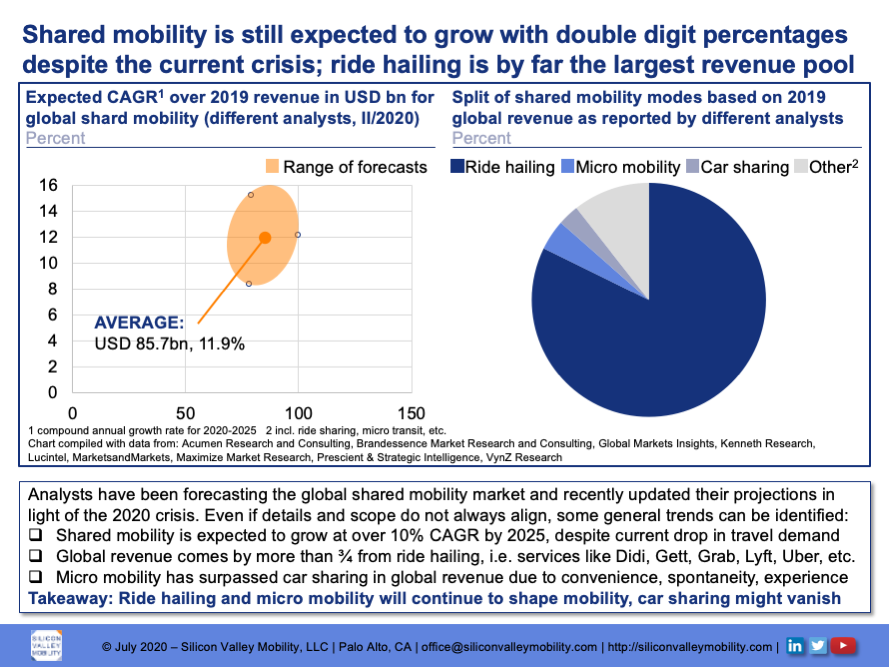
Chart of the Month by Silicon Valley Mobility for July 2020 – Shared mobility is here to stay

A client recently asked if it is about time to drop the “S” in “ACES”. The underlying question was if shared mobility actually has a future in light of the 2020 crisis with people concerned about sharing and no one traveling anywhere. So here is my answer:

As the chart summarizes, analysts still see double digit growth for shared mobility in recently updated revenue forecasts for 2025. The market is largely driven by ride hailing, i.e. services like Didi, Gett, Uber, etc. Micro mobility (scooters and bicycles), which operate with relatively low fees, have surpassed car sharing in global revenues in 2019. While ultimate conclusions should be done with caution, it seems possible that car sharing might not remain in key market through the 2020s.

Such trends emphasize that consumers increasingly appreciate mobility “access over ownership”, i.e. services are key. That does not however automatically mean “sharing” as e.g. ride hailing is not really a shared trip.

Given those observations, one might want to use “commoditization” instead of “shared mobility”. In that sense – yes, we might drop the “S” in “ACES” and replace it with another “C”. That would make it “ACEC”, which does not roll off of the tongue nicely.

Thoughts anyone?

Preview of plenary presentation at AVS20

Preview of plenary presentation at AVS20

Here’s a preview of my talk at the Automated Vehicles Symposium next week.

Abstract: Sensors are arguably one of the most important components in an automated driving system as they are the input to everything in the control system including artificial intelligence processes. While it is uncontested that cameras, radar, LiDAR, and others all have strengths in detecting objects, there is also great debate what the optimal solution and combination of sensors for an automated vehicle is. While this presentation does not aim to answer the question about the optimal solution, it will give an overview of the current debate, research activities, product solutions, and market trends. The audience will recognize several examples and hopefully also take note of thus far missed recent advances. In that sense, this talk aims to initiate further discussion regarding automated vehicle sensors at the conference and beyond.

Webpage: https://lnkd.in/gMv9-fb

Silicon Valley Mobility Chart of the Month, June 2020

Silicon Valley Mobility Chart of the Month, June 2020

Deciding between keep or cut.

This month we review recent news about mobility related ventures that got impacted by the pandemic. While there are quite some bad news, it should also not go unnoticed that there’s good news as well. Seemingly, it is not about “all or nothing” but about “the right” thing.

The question becomes how to decide what tasks, projects, investments etc. to keep and what to let go.

The key to success is to prioritize the portfolio from the top using a metric that is unique to one organization and also to let gut feeling play a role to make sure the result is the right thing. Communication matters a lot in this as the team needs to be coached in a potentially different situation, and therefore it is important to motivate.

While we do know how long past downturns lasted, no one can tell how long this one will take. Competitors also don’t know and are probably asking the same question. However, one thing is for sure, that a crisis will be over at some point and it is important to get through a challenging situation with a streamlined portfolio and a motivated team.

Microelectronics Power the Future of Mobility – Part 2: Opportunities for Electronics

Microelectronics Power the Future of Mobility – Part 2: Opportunities for Electronics

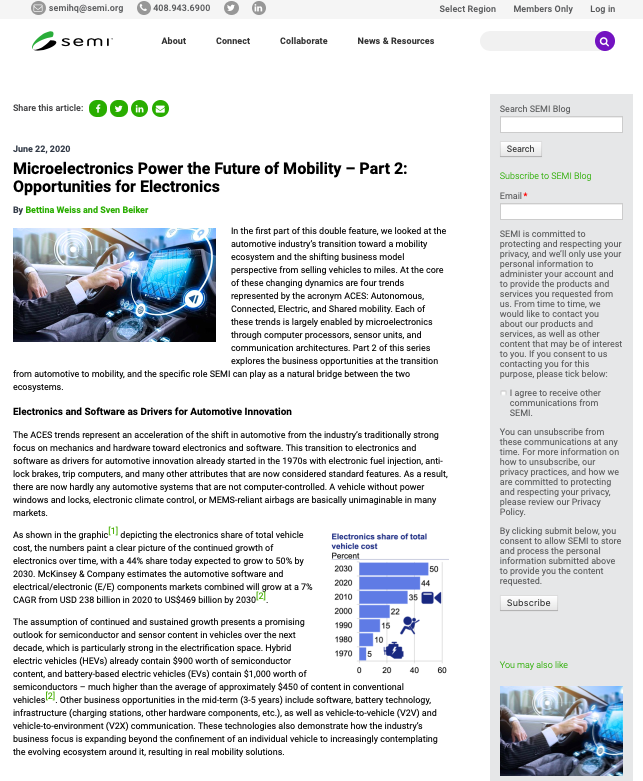
Microelectronics Power the Future of Mobility – the second part of the SEMI article how electronics enable much of autonomous, connected, electric, and shared mobility

We discuss here the estimates that the automotive software and electrical/electronic (E/E) components markets combined will grow at a 7% CAGR from USD 238 billion in 2020 to US$469 billion by 2030.

For me it is always important to note that this is not an entirely new trends but goes back to the 1970s when electronic fuel injection, ABS, and on-board computer were introduced.

The ACES trends now show great opportunity for the automotive and electronics industries to work even closer together, which is what SEMI fosters with the Global Automotive Advisory Council and the Smart Mobility initiative.


Microelectronics Power the Future of Mobility – Part 1: Autonomous, Connected, Electric and Shared

Microelectronics Power the Future of Mobility – Part 1: Autonomous, Connected, Electric and Shared

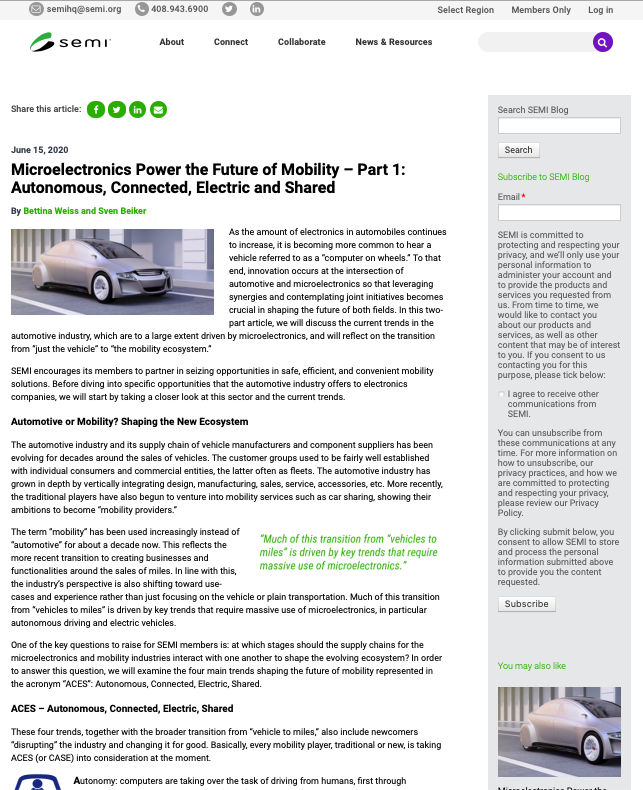
Microelectronics Power the Future of Mobility – nice write-up with my colleagues at SEMI. We are highlighting how electronics enable much of autonomous, connected, electric, and shared mobility. The numbers speak for themselves: by 2025, 14% of all integrated circuits produced globally are projected to go into vehicles.

Great opportunities for the auto and electronics industries to collaborate even more. For that, see also SEMI’s Smart Mobility initiative and the Global Automotive Advisory Council.

In the forthcoming second part, we will be adding that this is not entirely new as electronics have already contributed greatly to efficiency, safety, and convenience of automobiles since the 1970s. Stay tuned…


Silicon Valley Mobility Chart of the Month, May 2020

Silicon Valley Mobility Chart of the Month, May 2020

Happy anniversary Silicon Valley Mobility! It’s been 3 great years and with that about time to review how it has been going and what the firm actually is. Therefore, as many have been asking about details and specifics, here’s “Silicon Valley Mobility by the Numbers”.

Just recently the 50th client found its way to the firm and most engagements last 12 months or longer. About 20% of the project volume is from speaking engagements, which says that most engagements are non-public consulting projects with clients that are not advertised on the website. And there have been thus far 6 advisory board positions at startups that are also an important part of those engagements and learning.

Silicon Valley Mobility also has a network of almost 100 on-demand domain experts who are ready to team up for projects as needed. Finally, also the vast connections on LinkedIn help to mutually seek and give advice with colleagues.

Thank you all!

The Future of the Automated Mobility Industry: A Strategic Management Perspective

The Future of the Automated Mobility Industry: A Strategic Management Perspective

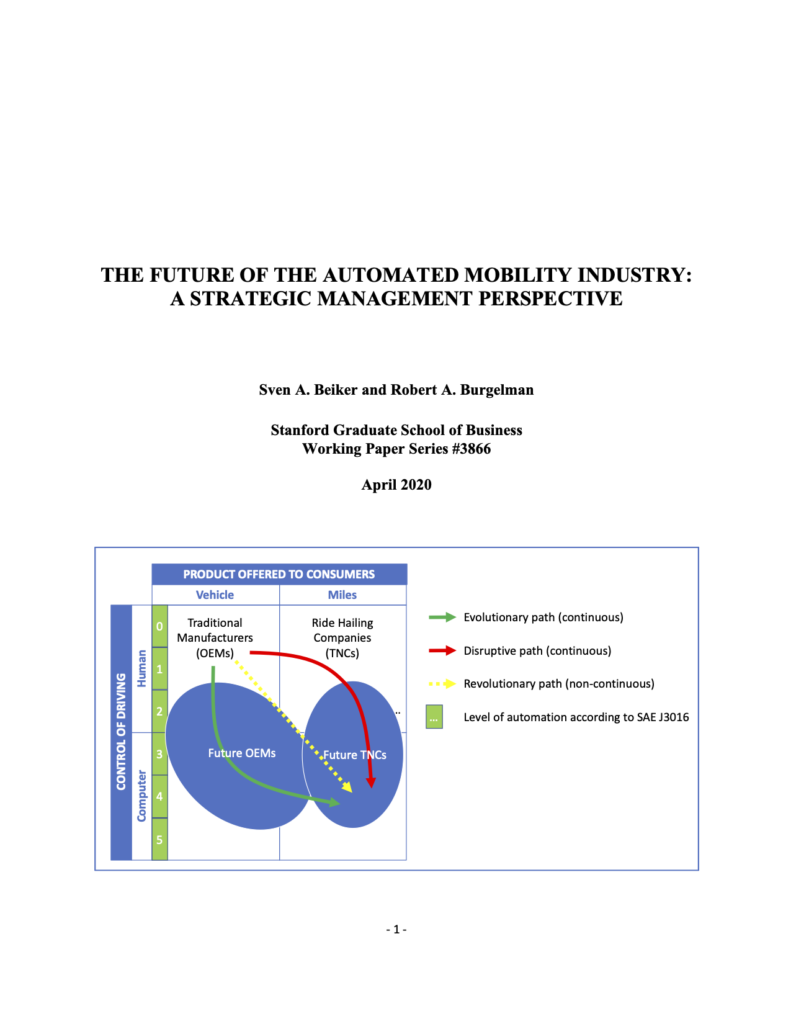
I am proud to have co-authored this paper with Prof. Robert Burgelman at the Stanford University Graduate School of Business.

Our paper examines the automation and sharing aspects of the competitive dynamics of the emerging automated mobility industry. It applies strategic management, technological innovation and forecasting frameworks to examine how the different categories of industry entrants position themselves and interact with one another, and their differential chances for success.

Related to the different types of entrants it considers various criteria of success, including expected market share of vehicle sales versus miles serviced, and the number of systems, technology solutions, or licenses sold. Whether firms enter the automated mobility industry with a lateral move from an adjacent industry or as startups without preexisting experience turns out to be an important strategic distinction for predicting success.

The rate at which the industry is shifting also plays an important role because it defines how much time incumbents have to adapt to change and how much time new entrants have before their investments must begin to generate positive cash flows.Our analysis suggests that tech companies, ADAS suppliers, and startups with a welldefined focus are most likely to succeed. The paper ends with highlighting important strategic issues for further discussion with automotive industry researchers, industry analysts, and leading practitioners.

Keywords: automotive industry, automated driving, autonomous driving, autonomous vehicles, shared mobility, driver assistance, ADAS, strategy, disruption, innovation management


Silicon Valley Mobility Chart of the Month, Apr 2020

Silicon Valley Mobility Chart of the Month, Apr 2020

“Don’t go where the puck is, go where it is going to be.” – this famous saying from hockey also applies to the mobility industry, innovation strategy, and also crisis management. There are many examples where a startup aims to be “the next” of something, e.g. “the next Tesla”. Or we might say in this current crisis that “sharing is a thing of the past”.

But what we do all too often is connecting just too few data points and extrapolating from them under the assumption that things will evolve linearly. We much rather need to account for all the twists and turns that those developments might take and therefore we should not aim to be “the next” of something but to create our own future. We need to envision what it will be, and then think backwards how we will have gotten there.

Some food for thought, definitely applies to the thinking what autonomous, connected, electric, and shared mobility will be in the future and how they might be affected by the current crisis.

Silicon Valley Mobility Chart of the Month, Mar 2020

Silicon Valley Mobility Chart of the Month, Mar 2020

A slightly different analysis of the California DMV 2019 Autonomous Vehicle Disengagement Reports that looks deeper into the narrative of where and why disengagements were encountered in 8,885 cases over 2.9m miles covered by 652 vehicles operated by 28 companies. One finds for instance that companies describe potentially similar cases in different terms and varying level of detail. And also, companies focus on different locations for testing, such as some report mostly disengagements on highways and others more on city streets. All this shows that the disengagement reports must not be used as a competitive analysis, let alone “ranking”, of companies. But the reports might serve as an indication how far the industry of autonomous driving has come as a whole, with challenges still in negotiating situations with humans, especially in what is called by some companies “aggressive” or “reckless” behavior. And also, the analysis of a vast number of disengagements shows that quite often the “planner” seems to have problems, which might be an indication that stand-alone planning might not be the only way toward automated vehicles in public and a more collaborative approach might be in order.

Silicon Valley Mobility Chart of the Month, Feb 2020

Silicon Valley Mobility Chart of the Month, Feb 2020

Quo vadis, autonomous driving? What can we say with near certainty and what only with some probability about autonomous driving? I have made two very interesting observations this month: (1) an investor told me “the days of burning money in a parking lot are over” and (2) the first Waymo test vehicle outside my house. Both observations taken together lead me to believe that funding for (at least early stage) AV companies is dwindling and Waymo might get really close to a “real” public launch now. Watch my video and join the discussion – what do you observe and what do you think?

Silicon Valley Mobility Chart of the Month, Jan 2020

Silicon Valley Mobility Chart of the Month, Jan 2020

Here we are in 2020 and where are the flying cars and where are the self-driving automobiles? At the beginning of a new decade I review my own forecasts from the past 10+ years and highlight things I got right and those that were a bit off. I also recommend that “forecasting” should rather be done as “projections”, i.e. one is at some point in time now and projects into the future. This should be done in different categories, such as events / innovations that are “certain”, “probable”, or simply just “possible” to happen. Either way, this makes for a interesting self-reflection that I can only recommend to everyone in the field of new mobility and future thinking. It is always good to look back “… what was I thinking?!” I hope you agree this deserves a 7:42 min video. Let me know what you think…

© 2017-2026 - Silicon Valley Mobility, LLC 1102 Clark Way, Palo Alto, CA 94304, USA